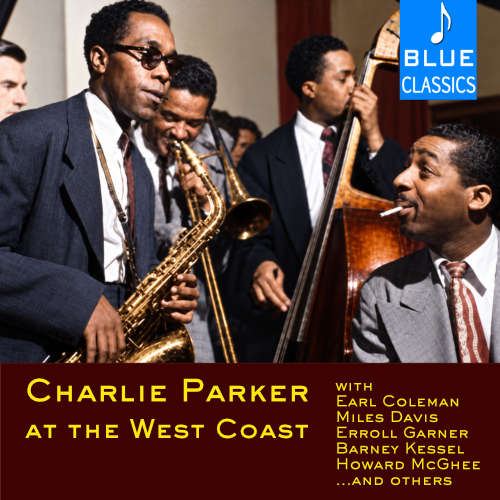
Title: AT THE WEST COAST
Year: 1946
Category: JAZZ,BLUECLASSICS
- 1. Stupendous 02:44
- 2. Dark Shadows 03:56
- 3. Cheers 02:59
- 4. Cool Blues 02:56
- 5. This Is Always 03:03
- 6. Carvin' the Bird 02:34
- 7. Relaxin' at Camarillo 02:45
- 8. Hot Blues 01:52
- 9. Bird's Nest 02:40
- 10. A Night in Tunisia 02:54
- 11. Yardbird Suite 02:29
- 12. Lover Man 03:10
- 13. Max is Makin' Wax 02:23
- 14. Moose the Mooche 02:48
- 15. The Gypsy 02:17
- 16. Be-Bop 02:44
- 17. Ornithology 02:59
- Charlie Parker – alto sax
Tracks 1, 3, 6, 7:
Recorded on February 26, 1947, C. P. MacGregor Studios, Hollywood, CA
Howard McGhee – trumpet
Wardell Gray – tenor sax
Dodo Marmarosa – piano
Barney Kessel – guitar
Red Callender – bass
Don Lamond – drums
Tracks 2, 4–5, 8:
Recorded on February 19, 1947, C. P. MacGregor Studios, Hollywood, CA
Erroll Garner – piano
Red Callender – bass
"Doc" West – drums
Tracks 2, 5:
Earl Coleman – voice
Tracks 9–10, 13, 16–17:
Recorded on March 28, 1946, Radio Recorders Studios, Hollywood, CA
Miles Davis – trumpet
Lucky Thompson – tenor sax
Dodo Marmarosa – piano
Arvin Garrison – guitar
Vic McMillan – bass
Roy Porter – drums
Tracks 11–12, 14–15:
Recorded on July 29, 1946, C. P. MacGregor Studios, Hollywood, CA
Howard McGhee – trumpet
Jimmy Bunn – piano
Bob Kesterson – bass
Roy Porter – drums

AT THE WEST COAST
by Charlie Parker with Erroll Garner, Barney Kessel
Charlie Parker’s years in California occupy a special place in his career. Between late 1945 and 1947 he spent extended periods in Los Angeles, working in clubs, meeting musicians, recording for Ross Russell’s Dial label, and moving through a rapidly developing West Coast bebop scene. The period produced some of his most important recordings, but it was also one of the most unstable periods of his life.
Parker first arrived in Los Angeles in December 1945, when he and Dizzy Gillespie travelled west for an engagement at Billy Berg’s Hollywood jazz club. Their appearance introduced the new bebop language to West Coast audiences, but the engagement did not lead to a settled new career for Parker. Instead, Los Angeles became the setting for a complicated two-year period in which he moved between clubs, jam sessions, private accommodations and recording studios. Parker’s official biography describes these years as a turbulent period of performances, informal playing and recording activity.
The first sessions represented here belong to 1946. On March 28, Parker recorded for Ross Russell’s Dial Records at Radio Recorders Studios in Hollywood with an unusually strong septet: Miles Davis on trumpet, Lucky Thompson on tenor saxophone, Dodo Marmarosa on piano, Arvin Garrison on guitar, Vic McMillan on bass and Roy Porter on drums.
The session produced four important Parker compositions or arrangements: “Moose the Mooche,” “Yardbird Suite,” “Ornithology” and “A Night in Tunisia.” “Yardbird Suite” and “Ornithology” belong among the central themes of the emerging bebop repertoire, while “Moose the Mooche” became one of Parker’s characteristic blues-based originals. The session was supervised by Ross Russell, whose Dial label was becoming closely identified with Parker’s work.
The personnel was not accidental, but neither was Parker working with a permanent West Coast band. The musicians were drawn from the active Los Angeles jazz community. Miles Davis was still at an early stage of his career, Lucky Thompson was one of the leading tenor saxophonists on the West Coast, Dodo Marmarosa was a highly respected young pianist, and Roy Porter was an important local drummer. The variety of personnel found on Parker’s California dates reflects the nature of the Los Angeles jazz scene at the time: musicians were frequently available for different combinations, and recording sessions were assembled according to the circumstances of a particular date.
Four months later, on July 29, Parker recorded another Dial session at C. P. MacGregor Studios. This time he was joined by trumpeter Howard McGhee, pianist Jimmy Bunn, bassist Bob Kesterson and drummer Roy Porter. The session produced “Max Is Makin’ Wax,” “Lover Man,” “The Gypsy” and “Be-Bop.”
The change of musicians is particularly revealing. Parker was not maintaining a fixed quintet in Los Angeles. Instead, his recording groups were assembled from musicians with whom he was working or whom producer Ross Russell could bring together. McGhee was one of the strongest bebop trumpeters on the Los Angeles scene and had already developed a close musical association with Parker. Roy Porter had also appeared on the March session, providing continuity between the two dates.
The July session also became notorious because of Parker’s condition during the recording of “Lover Man.” His heroin and alcohol problems had become increasingly serious, and the session took place under extremely difficult circumstances. The recording is therefore as much a document of Parker’s personal crisis as of his musical importance. Contemporary and later accounts emphasize that his physical condition had deteriorated severely by this point.
After the July session, Parker was admitted to Camarillo State Hospital in California, where he remained for several months. His later composition “Relaxin’ at Camarillo” took its title from this experience.
When Parker returned to the Los Angeles recording studio in February 1947, the change was striking. On February 19 he recorded at C. P. MacGregor Studios with pianist Erroll Garner, bassist Red Callender and drummer “Doc” West. Vocalist Earl Coleman joined the group for “This Is Always” and “Dark Shadows.”
This was a very different group from the one heard seven months earlier. Garner, already a distinctive pianist with a highly personal rhythmic language, had his own musical identity quite apart from bebop. Yet he fitted Parker’s music remarkably well. The quartet format also gave Parker much more space than the seven-piece session of 1946.
The February 19 session produced “This Is Always,” “Dark Shadows,” “Bird’s Nest” and “Cool Blues.” The latter was also circulated under the title “Hot Blues.” The session was produced by Ross Russell for Dial, and its personnel demonstrates again how Parker’s California recordings were assembled from the musicians available within the local scene.
Only one week later, on February 26, Parker returned to C. P. MacGregor Studios for what became one of the most famous sessions of his West Coast period. The lineup was much larger: Howard McGhee on trumpet, Wardell Gray on tenor saxophone, Dodo Marmarosa on piano, Barney Kessel on guitar, Red Callender on bass and Don Lamond on drums.
The four titles recorded that day were “Relaxin’ at Camarillo,” “Cheers,” “Carvin’ the Bird” and “Stupendous.” The session is sometimes referred to as Charlie Parker’s New Stars. It brought together several of the most important musicians on the Los Angeles scene in a single group and has often been regarded as one of the outstanding Parker sessions of the period.
The title “Relaxin’ at Camarillo” points directly to Parker’s recent hospitalization. The piece is one of the clearest examples of his ability to transform personal experience into musical material. At the same time, “Cheers,” “Carvin’ the Bird” and “Stupendous” show the very different contributions of Howard McGhee, who was not only Parker’s trumpet counterpart at the session but also a composer. Both “Cheers” and “Stupendous” are McGhee compositions, as is “Carvin’ the Bird.”
Why do these sessions have such different personnel? The simplest answer is that Parker did not have a fixed West Coast working band. During this period he was moving through the Los Angeles jazz community rather than establishing a permanent ensemble. Different recording dates therefore brought together different combinations of musicians. Some musicians—such as Roy Porter, Red Callender, Dodo Marmarosa and Howard McGhee—appear on more than one date, while others were engaged for a specific session.
Ross Russell was another important factor. Dial was a small independent label, and Russell was personally involved in the recording projects. The sessions were therefore assembled around Parker and the needs of particular recording dates rather than around the personnel model of a large established jazz orchestra. The result is a fascinating series of changing ensembles, each highlighting a different aspect of Parker’s playing.
There is also an important difference between Parker’s California work and his later New York sessions. In New York, especially from late 1947 onward, he increasingly worked with a more stable group including Miles Davis, Duke Jordan, Tommy Potter and Max Roach. The West Coast recordings, by contrast, have a more exploratory quality precisely because the personnel changes from session to session.
Los Angeles itself played an important role. The city had a substantial network of working musicians, clubs, recording studios and film-industry musicians. Parker could therefore encounter musicians who were already deeply familiar with jazz while also finding players whose backgrounds differed from those of the New York bebop scene.
These recordings also document a period of personal extremes. Parker could produce music of extraordinary originality while simultaneously struggling with addiction and unstable living conditions. The contrast is especially striking when comparing the July 1946 “Lover Man” session with the February 1947 performances. By the latter date he had come through the Camarillo hospitalization and was again producing some of his most assured studio performances.
The West Coast period ended later in 1947, when Parker returned to New York. There he resumed recording for Dial and Savoy and soon began developing the groups and collaborations that would define the next stage of his career.
At the West Coast therefore presents Parker not as the leader of one fixed band, but as the centre of a constantly changing musical network. Miles Davis, Lucky Thompson, Dodo Marmarosa, Howard McGhee, Erroll Garner, Wardell Gray, Barney Kessel, Red Callender, Roy Porter and the other musicians who surrounded him brought different musical identities to the sessions. Parker absorbed all of them into his own language.
The variety is part of what makes these recordings so compelling. They show Parker listening, adapting and responding to different musicians while maintaining his unmistakable sound. Across the sessions of 1946 and 1947, the personnel changes—but Parker's musical identity remains constant.
EU Public Domain Notice
The historical sound recordings included in this release are in the public domain in the European Union. Blue Music Group has created a new digital restoration and mastering of these historical recordings. The digital restoration and mastering by Blue Music Group are protected by applicable copyright and related rights. Rights may differ in other territories, including the United States. This release is not intended for distribution in the United States.